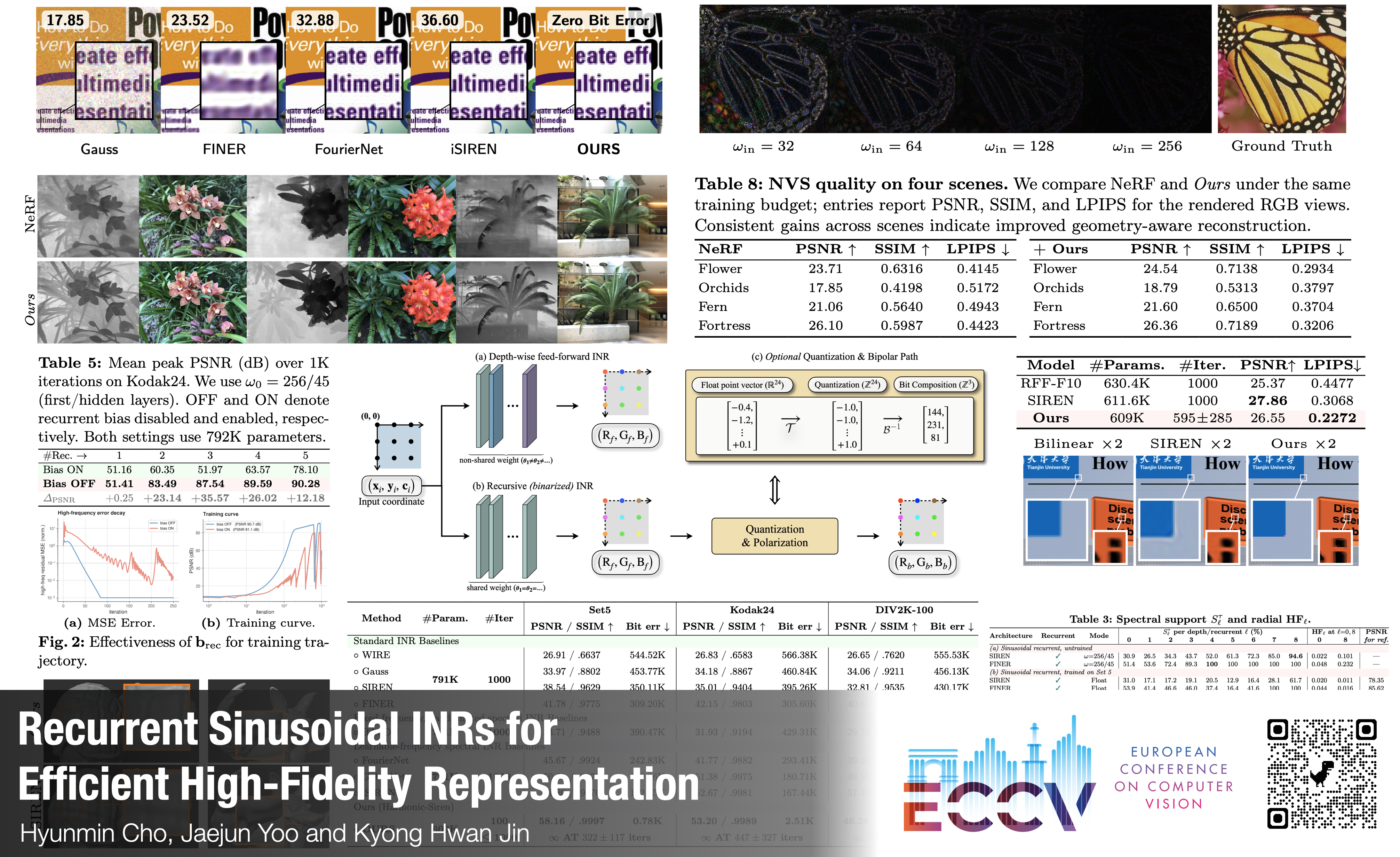
Recurrent Sinusoidal INRs for Efficient High-Fidelity
Representation:
Harmonic-line Spectrum Perspective
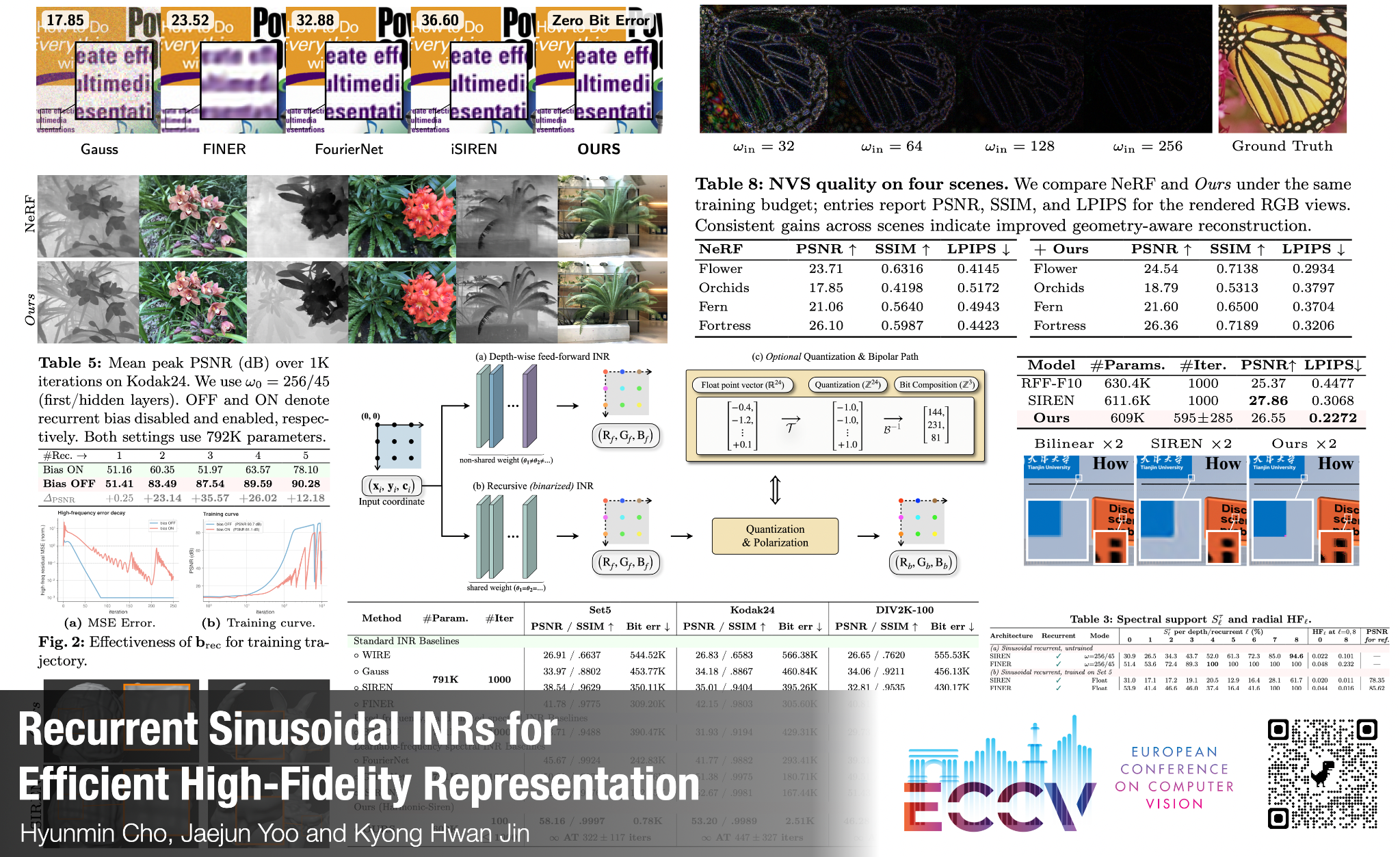
Abstract
Implicit neural representations (INRs) often improve fidelity by increasing depth or multiresolution parameters, which raises model size and compute. We study a different approach: iterative latent refinement with a shared sinusoidal block under a fixed parameter budget. We show that sinusoidal activations induce a harmonic line-spectrum, which provides a spectral interpretation of why recurrent unrolling can enrich effective spectral support without increasing the number of parameters. Based on this perspective, we propose a recurrent sinusoidal INR and, in the quantized setting, combine it with bipolar code-space supervision for exact discrete reconstruction. On RGB image benchmarks, our method reaches substantially higher fidelity than feed-forward baselines with fewer parameters and fewer optimization steps. The proposed method transfers favorably to super-resolution, NeRF, and SDF tasks. These results suggest recurrence as a simple and modular alternative to increasing independently parameterized depth in INRs.
Why? — Fidelity Without More Parameters
Coordinate-based INRs suffer from spectral bias: they fit low-frequency structure readily but recover fine, high-frequency detail only slowly. The usual fixes — deeper networks, multiresolution grids, richer encodings — buy fidelity by spending parameters, memory, and optimization steps.
It helps to read an INR as three stages,
where $\mathcal{E}$ lifts coordinates into a higher-dimensional embedding, $\mathcal{F}$ transforms it into a latent feature, and $\mathcal{D}$ maps that feature to the output. The key difficulty is not only how coordinates are encoded, but whether the latent state can be refined enough to capture fine-scale structure under a fixed budget. This motivates our central question:
Can high-frequency reconstruction be improved by repeatedly refining an internal latent state while reusing a compact set of parameters — rather than adding independently parameterized depth?
Recurrence is a natural mechanism: unrolling a weight-tied update for $R$ steps increases effective depth while reusing the same weights, and can be read as a learned iterative refinement algorithm. The question is why this should help a sinusoidal INR. The answer is spectral.
Sinusoidal Layers Induce a Harmonic Line-Spectrum
The encoder is a learnable Fourier feature map. Following SIREN, the sinusoidal lifting
maps coordinates to a set of sinusoidal bases with learnable frequencies $\boldsymbol{\Omega}_i=\omega_{\mathrm{in}}\mathbf{w}_i$ and phases $\phi_i$; the bandwidth scalar $\omega_{\mathrm{in}}$ sets the overall frequency scale. Empirically, raising $\omega_{\mathrm{in}}$ consistently improves high-pass reconstruction at every training stage (e.g., 23.51 → 36.45 dB at just 200 iterations).
A hidden sine layer creates new frequencies. Feed the multi-tone code $u_j(\mathbf{x}) = \beta_j + \sum_i \alpha_{j,i}\sin(\theta_i(\mathbf{x}))$ through another sine. By the Jacobi–Anger expansion,
so the layer emits spectral lines at integer combinations of the encoder frequencies, $\boldsymbol{\Omega}' = \sum_i k_i\,\boldsymbol{\Omega}_i$ — sums, differences, and higher-order harmonics — rather than merely reweighting existing ones. Stacking (or unrolling) sine layers therefore drives a progressive harmonic enrichment of the reachable spectrum:
This is the crux: because each shared application of a sine block expands the effective spectral support, recurrent unrolling buys harmonic richness for free under a fixed parameter count — the architectural counterpart of adding depth. We measure this prediction directly on the network's own activations, next.
Validating the Harmonic Line-Spectrum
The theory makes a sharp, falsifiable claim: each shared sinusoidal step should add spectral lines at integer combinations of existing frequencies, so the reachable spectrum should broaden with every recurrent step. We measure this directly on the network's own hidden activations.
What we measure
On a regular $H\times H$ coordinate grid we forward each network and capture the hidden state at every recurrent / depth index $\ell$, $\;\mathbf{h}^{(\ell)} = \sigma\!\big(\omega\,W^{(\mathrm{rec})}\mathbf{h}^{(\ell-1)}\big)$. We take its per-channel 2D DFT, then channel-average and peak-normalize the magnitude in dB,
and read off two scalars per step — one for breadth, one for high-frequency strength:
where $R_\ell(k)$ is the radial profile of $M_\ell$ at radius $k$ from DC. Intuitively, $S_\ell^\tau$ counts how many frequency bins are active, and $\mathrm{HF}_\ell$ measures how much energy lives in the upper (Nyquist) half of the spectrum.
What we find
Evaluated across $\ell = 1\!\to\!8$, the three recurrence regimes behave completely differently — and exactly as the harmonic-line-spectrum view predicts:
| Recurrence regime | Mechanism | Spectral support $S_\ell$ ($\ell{=}1 \to \ell{=}8$) |
Radial HF$_\ell$ | Exact fit (BER = 0)? |
|---|---|---|---|---|
| Sinusoidal, weight-tied (Ours) | integer-combination closure $\Omega^{(\ell+1)}\!\subseteq\!\operatorname{span}_{\mathbb{Z}}\Omega^{(\ell)}$ | 30.9% → 94.6% ↑ monotone | grows ↑ | ✓ (∞ dB) |
| Iterative SIREN, fixed-point (iSIREN) | contractive equilibrium $z^\star = F_\theta(z^\star,\mathbf{x})$ | 33.5% → 33.5% → saturates | 0.008 → flat | ✗ (≤ 47.16 dB) |
| Non-sinusoidal recurrence | no harmonic-generation mechanism | collapses ↓ | ↓ | ✗ |
Spectral support $S_\ell^\tau$ and radial HF$_\ell$ of hidden activations across recurrent / depth steps (random initialization). Endpoint values are reported; arrows summarize the trend over $\ell$.
- Sinusoidal recurrence (Ours) enriches the spectrum monotonically — spectral support climbs 30.9% → 94.6% as steps accumulate, precisely the integer-combination closure the Jacobi–Anger expansion predicts. More steps ⇒ broader support ⇒ more reachable high frequencies, all at a fixed parameter count.
- Fixed-point iterative SIREN saturates. An input-injected, contractive recurrence converges to a single equilibrium $z^\star$, so its spectrum stops changing after roughly one iteration (support flat at 33.5%, HF flat at 0.008) — capping fidelity well short of exact (≤ 47.16 dB, never BER = 0).
- Non-sinusoidal recurrence collapses. Without a sine nonlinearity there is no mechanism to generate new harmonics, so repeated application shrinks rather than enriches the support.
The experiment cleanly separates sinusoidal growth from recurrent collapse: it is the combination of (i) a sinusoidal nonlinearity and (ii) explicit finite unrolling — not recurrence alone — that expands effective spectral support. This is the spectral mechanism that turns extra recurrent steps into fidelity gains, and explains why our finite, non-contractive unrolling can reach exact reconstruction that equilibrium-style recurrence cannot.
Method: Recurrent Sinusoidal INR
We instantiate $\mathcal{F}$ as a single shared sinusoidal block and iteratively refine the latent state. Given a coordinate $\boldsymbol{x}$, we initialize with a sinusoidal projection and refine for $R$ recurrent steps with a weight-tied transformation, then read out:
$W^{(\mathrm{in})},W^{(\mathrm{rec})},W^{(\mathrm{out})}$ are bias-free linear maps (for stability under unrolling), with the recurrent map $W^{(\mathrm{rec})}$ shared across all steps, and $\sigma(\cdot)$ the elementwise sine. Each application expands harmonic interactions while preserving the parameter count. Crucially, the block has no coordinate re-injection and is run for a finite $R$ — an explicit unrolling, not a contractive fixed-point solve.
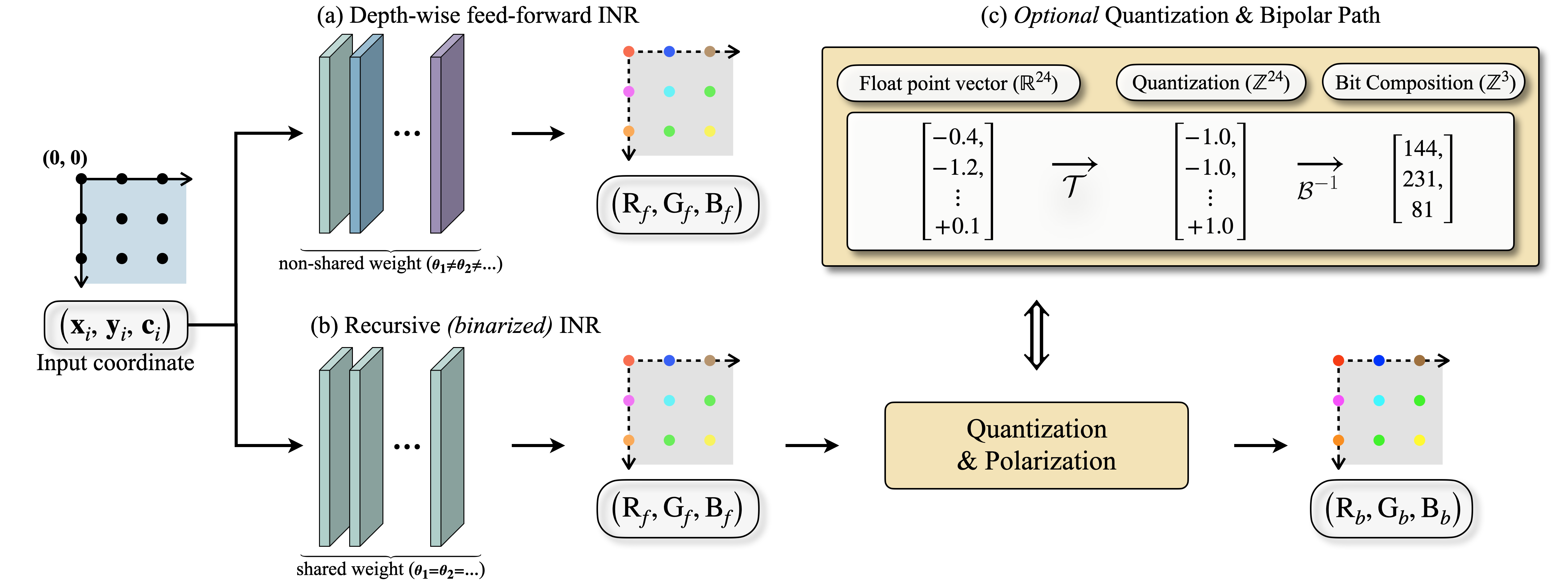
Feed-forward vs. recurrent INRs under a fixed parameter budget. (a) A depthwise feed-forward INR maps coordinates to RGB with non-shared weights ($\theta_1\!\neq\!\theta_2\!\neq\!\dots$) in FP32. (b) Our recurrent INR reuses a single shared module ($\theta_1\!=\!\theta_2\!=\!\dots$), unrolling it for $T$ steps with backpropagation through time. (c) Optionally, a threshold/sign operator $\mathcal{T}$ and inverse bipolar map $\mathcal{B}^{-1}$ convert the bipolar output into exact UINT8 values.
Optional: bipolar code-space supervision (quantized setting)
For lossless fitting we can supervise in a binarized code space rather than regressing intensities. The quantized target $y_p\in\{0,\dots,2^B-1\}$ becomes a zero-centered bipolar codeword via a $B$-bit Gray encoder $\Gamma$,
Bipolar codewords are zero-centered (matching the symmetric range of sine) and share a constant norm, so training reduces to a single cosine-alignment objective; Gray coding keeps neighboring quantization levels one bit apart. This is an optional add-on for the quantized regime — the fidelity gains come from recurrence itself.
More Recurrence ⇒ Higher Fidelity, Same Parameters
The spectral prediction is directly testable in fidelity, too: at a fixed optimization step and a fixed 593.7K parameters, simply unrolling the shared block for more steps monotonically improves reconstruction — a +23.7 dB swing from feed-forward to $R{=}5$ at step 500.
| #Recurrent steps | Feed-forward | $R{=}2$ | $R{=}3$ | $R{=}4$ | $R{=}5$ |
|---|---|---|---|---|---|
| PSNR (dB) @ step 500 | 39.72 | 46.36 +6.6 | 54.77 +15.0 | 60.84 +21.1 | 63.38 +23.7 |
| #Param. | 593.7K | 593.7K | 593.7K | 593.7K | 593.7K |
Reconstruction quality at optimization step 500 vs. number of recurrent unrolling steps. $\Delta$ is the PSNR gain over the feed-forward (single-pass) baseline. Parameter count is identical across columns.
Takeaways
- Recurrence ≈ depth, for free. A shared sinusoidal block, unrolled, enriches the harmonic line-spectrum without adding parameters — a spectral reason recurrence helps INRs.
- Mechanism, verified. Direct DFT measurement confirms sinusoidal recurrence grows the spectral support (30.9% → 94.6%), separating it from contractive iterative-SIREN (saturates) and non-sinusoidal recurrence (collapses).
- More steps, more fidelity. Under a fixed parameter budget, each added recurrent step keeps raising reconstruction quality (+23.7 dB at $R{=}5$).
- Lossless when you want it. As an optional add-on for quantized signals, bipolar Gray-coded supervision additionally yields exact (zero-bit-error) reconstruction — but the fidelity gains come from recurrence itself.
BibTeX
@InProceedings{10.1007/978-3-032-37574-2_22,
author="Cho, Hyunmin
and Yoo, Jaejun
and Jin, Kyong Hwan",
editor="Favaro, Paolo
and Kukelova, Zuzana
and Maki, Atsuto
and Rohrbach, Anna
and Schindler, Konrad
and Tombari, Federico",
title="Recurrent Sinusoidal INRs for Efficient High-Fidelity Representation",
booktitle="Computer Vision -- ECCV 2026",
year="2026",
publisher="Springer Nature Switzerland",
address="Cham",
pages="385--403",
abstract="We study sinusoidal recurrence as an iterative mechanism for harmonic spectral enrichment in implicit neural representations (INRs). Our analysis reveals that sinusoidal activations induce a harmonic line spectrum, providing a spectral account of how recurrent unrolling enriches the effective spectral support. We realize this principle with a shared sinusoidal block that iteratively refines the latent representation. We empirically validate the resulting spectral behavior against feed-forward INRs, non-sinusoidal recurrent variants, and equilibrium-style sinusoidal models. Complementing this analysis, we evaluate the proposed architecture across image and 3D representation tasks. On RGB image benchmarks, our method achieves higher fidelity than feed-forward baselines with fewer parameters and fewer optimization steps, and it further transfers favorably to super-resolution, NeRF, and SDF tasks.",
isbn="978-3-032-37574-2"
}